
Tiders x402 Server
Tiders x402 Server lets you sell access to your data — install the server, point it at your database, set a price, and anyone on the internet can make micro payments to query your data instantly, with no contracts, accounts, or billing setup.
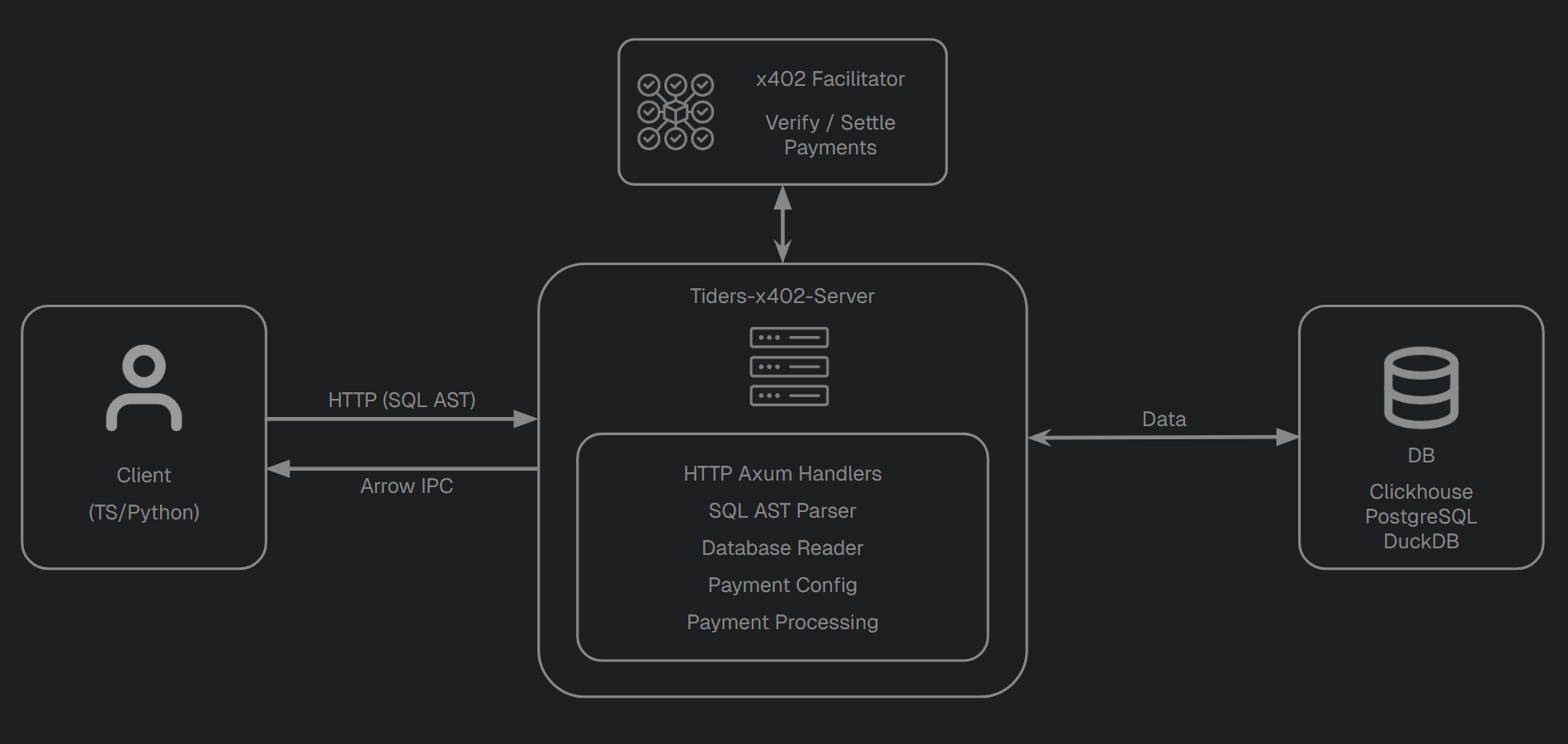
Buyers submit SQL queries over HTTP and receive results as efficient Apache Arrow IPC streams. You control what data is exposed, which tables are available, and how much each query costs — per row returned or a flat fee to access a table. Buyers interact using familiar SQL, but Tiders enforces a safe subset — blocking expensive operations like JOINs and subqueries — so your database stays protected and costs stay predictable.
Payments are handled by the x402 protocol, an open standard for HTTP-native micropayments. When a server needs payment it returns a standard 402 Payment Required response; a client with x402 support signs it, and the transaction settles in under a second using stablecoins — no accounts, no checkout pages, no minimum spend.
Under the hood, Tiders is a Rust server that connects to different databases such as DuckDB, PostgreSQL, or ClickHouse. Buyers query using familiar SQL, but Tiders enforces a safe subset — blocking expensive operations like JOINs and subqueries — so your database stays protected and costs stay predictable.
Serving raw data from your database through a paid API is the server’s core job. As an optional addition — because selling data is hard without showing buyers what they’re getting — the same server application can scaffold and publish interactive dashboards: fully customizable visual reports you design and your buyers explore in a browser, with a convenience button that hits the server’s x402-gated APIs to download the underlying data. The server works exactly the same with or without dashboards.
Think of the dashboard feature as a vending machine for data: buyers browse the dashboard to preview what’s available, then pay per request to access the full dataset. You stay in full control — what data is freely visible in the dashboard, which tables the server exposes, and how much each query costs, whether that’s per row returned or a flat fee to access a table.
New Here? Start with the Full Stack Example
tiders-stack repo is a ready-to-run end-to-end example that wires up a complete Tiders environment from scratch: ingestion pipeline, database, server config, dashboard, and a paying client — all in one repo. If you don’t have data or infrastructure already set up, start there before continuing here.
Three Ways to Use
| Mode | How | When to use |
|---|---|---|
| CLI Application | Install, write a YAML config file with available tables and prices, run tiders-x402-server start | Quick setup, no coding required, config-driven deployments |
| Dashboards | Optional dashboards can be scaffold with teh CLI’s tiders-x402-server dashboard <slug> and are fully customizable | Published alongside the API endpoints, allow buyers browse the data |
| SDK Library | Import in Rust, configure programmatically | Modifying server standard bahavior, embedding in larger rust applications, maximum flexibility |
See CLI Quick Start to get started.
Key Features
- Pay-per-query data access — charge a flat fee, per row returned, or a one-time fee for table metadata
- Tiered pricing — volume tiers, multiple tokens, and multiple networks per table
- Multiple databases — DuckDB, PostgreSQL, and ClickHouse backends
- CLI and SDK — run from a YAML config file (no code) or embed as a Rust/Python library
- Apache Arrow responses — efficient binary columnar format, significantly faster than JSON
- Safe SQL subset — parser blocks JOINs, GROUP BY, subqueries, and other expensive operations
- Embedded dashboards — scaffold and serve Evidence dashboards from the same binary, with x402 wallet-connect download buttons baked in
- Hot reload — tables, pricing, facilitator settings, and dashboard config reload on file change without a restart
- Observability — built-in OpenTelemetry tracing support
How Paid Requests Work
- A client sends a SQL query to
GET /api/query?query=…. - The server parses and validates the query, then estimates the payment options.
- If payment is required, the server responds with HTTP 402 and a list of payment options.
- The client signs a payment using their crypto wallet and resends the request with a
Payment-Signatureheader. - The server verifies and settles the payment through a facilitator, then returns the query results as Arrow IPC.
Endpoints at a Glance
| Path | Purpose |
|---|---|
GET / | Dashboards landing page (only when dashboards: is configured) |
GET /<slug>/ | Static Evidence dashboard, one per dashboards: entry |
GET /api/ | Server discovery document: tables, pricing, endpoints, version |
GET /api/query?query=… | Submit a SQL query (paywalled per the table’s price tags) |
GET /api/table/{name} | Full schema and pricing for a single table |
Project Structure
tiders-x402-server/
  server/          # Rust server library + CLI binary (Axum-based REST API + dashboard scaffolder)
    src/
      cli/           # YAML config loader, YAML validator, file watcher
      dashboard/     # Dashboard config, routes, scaffolder + embedded Evidence templates
      database/      # Database trait + DuckDB / PostgreSQL / ClickHouse backends + SQL parser/generators
      payment/       # Pricing model, payment config, x402 verify/settle, facilitator client
      handler_api_*.rs # Axum handlers for /api/, /api/query, /api/table/{name}
      lib.rs         # Server bootstrap (router, middleware, OTLP, graceful shutdown)
  cli-python/      # Python wheel that ships the CLI binary (pip install tiders-x402-server)
  examples/        # Python, Rust, and CLI server examples + sample data
  docs/            # mdBook documentation
  Cargo.toml       # Workspace configuration
Technology Stack
| Component | Technology |
|---|---|
| Web framework | Axum |
| Database | DuckDB, ClickHouse, PostgreSQL |
| Payment protocol | x402 V2 (via x402-rs types and x402-chain-eip155) |
| Data serialization | Apache Arrow IPC |
| SQL parsing | sqlparser |
| Blockchain primitives | Alloy |
| Dashboards | Evidence (Svelte) + wagmi + viem + @x402/evm |
| Observability | OpenTelemetry + tracing |